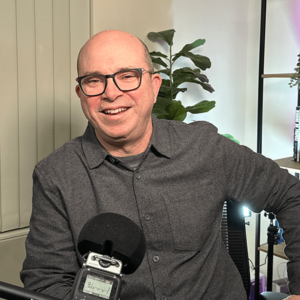
There is a statistic that stopped me in my tracks the first time I really sat with it – and it came up again when I was recording this episode with Dr. Christiaan (Chris) Willems for Podcasts Done For You Show.
Albert Mehrabian’s research found that 55% of communication is non-verbal. Another 38% is how you sound – the tone, the pace, the energy in your voice. That leaves a grand total of 7% for the actual words that come out of your mouth.
Seven per cent.
If you are a business professional creating video content, running a podcast, or showing up on Zoom calls with potential clients – and you have been focused almost entirely on what you say rather than how you show up – this episode is going to change the way you think about your on-screen presence.
Dr. Chris Willems is not your typical communications consultant. He spent more than 40 years in the performing arts and television – 25 of those years as a professional mime artist – before making the transition into corporate communications. That might sound like an unlikely background, but when you understand that mime is fundamentally about the analysis, manipulation, and stylisation of body language, it makes perfect sense. The mime artist who learned to communicate everything without a single word is now one of the most compelling voices on what it means to communicate powerfully in the visual world of online business.
Why Video Is Non-Negotiable for Business Professionals
One of the things Dr. Chris and I agreed on immediately is that the conversation about whether to show up on video is over. Before COVID, plenty of businesses were still resistant to Zoom – some IT departments wouldn’t even allow the software to be installed. Then almost overnight, video became the default mode of professional communication.
And it has stayed that way. A statistic Dr. Chris shared – even from a few years ago – is that 85% of all online communication is now via video. That number is not going to decrease. If anything, it will only continue to climb.
For podcast producers, this is especially relevant. The trend toward video podcasting is accelerating. Platforms like Apple are now introducing video capability, and YouTube has been a natural home for video podcasts for years. At Podcasts Done For You, we ensure our clients have video content available as reels and clips even when the primary format is audio – because that video content is what gets people into the show.
The point is simple: whether you are podcasting, presenting, pitching, or connecting on Zoom, how you show up on camera is now as important as how you show up in person. And just as you would not walk into a business meeting without thinking about your appearance and how you carry yourself, you need to bring that same intentionality to the camera.
The Fear of the Camera
One of the most honest and useful parts of our conversation was the discussion around camera fear. Dr. Chris acknowledged something that I see all the time with clients: people are genuinely reluctant to be on camera. They know they walk down the street every day, they go to the supermarket, people see them all the time – but there is something about the camera that makes them feel exposed and judged in a way that face-to-face interaction does not.
Dr. Chris explained why: the camera is not human. When you are in a meeting or a live presentation, you are receiving non-verbal feedback from the people in the room. You see them nod, you see them lean in, you see them smile. That feedback is what helps you regulate your performance in real time. The camera gives you none of that. It is a piece of glass with no response, and talking to it feels deeply unnatural.
But here is what he said that I think is worth remembering: the more you do it, the less foreign it becomes. Camera confidence is not a gift that some people are born with – it is a skill that can be learned and developed. The professionals you see on television who make it look effortless have years of practice and training behind them. When you are starting out, you are allowed to be a work in progress.
The Stylised Version of You
One of Dr. Chris’s trademark concepts is what he calls “the stylised version of you.” I want to make sure this lands properly because it is often misunderstood.
Stylisation is not fakery. It is not “fake it till you make it.” It does not ask you to be someone you are not. What it means is that you consciously think about where on the continuum from completely relaxed to highly formal you need to sit for a given context – and you adjust accordingly.
Think about how you already do this in everyday life. The way you talk to a colleague over coffee is different to the way you present at a conference. You are the same person, but you are a different version of yourself depending on the context. Stylisation on camera is the same principle made conscious and deliberate.
When you are recording a podcast or creating a business video, that is a highly stylised environment. You are talking to a piece of glass, you are performing to an audience you cannot see, and every aspect of how you show up – from your clothing to your lighting to your background – is a communication choice. Dr. Chris calls the active practice of noticing this and doing something about it “active awareness.” Not just knowing something, but acting on what you know.
Lighting: The Most Underrated Investment in Your On-Screen Presence
If there is one practical takeaway from this episode that will make an immediate, visible difference to how you come across on camera, it is this: sort out your lighting.
I shared in the episode that I use a ring light that I purchased for around $150 – and I actually demonstrated its effect on camera by putting my hand in front of it while we were recording. The difference is immediate and dramatic.
The reason lighting matters so much is simple: cameras are only as good as the light they have to work with. If you are recording with a basic webcam or a laptop camera in a poorly lit room, the camera is working hard to compensate, and the result is grainy, dark, and unflattering footage. Add a decent light source, and suddenly that same camera produces footage that looks professional.
Dr. Chris mentioned the classic three-point lighting setup used in television production: a key light, a fill light, and a backlight that separates you from the background. You do not need all three to start – even a single key light positioned at 45 degrees in front of you will make a significant improvement. The Australian teleprompter company and light recommendations I use and recommend are available in the episode resources at https://link.podcastsdoneforyou.com.au/access.
Background: You Are Not the Only Thing in the Frame
Here is a thought that Dr. Chris put to me that I want to sit with you for a moment: on camera, you do not have a neutral background. You share the frame with whatever is behind you – and that content communicates something about you before you have said a single word.
Dr. Chris shared an example of a client he worked with recently. Her office looked fine to the naked eye, but on camera there was a printer on one side and a random object on the other. They rearranged the space, added her professional qualifications to the wall, cleared the clutter, and suddenly – before she had even spoken – her background was communicating her credibility and expertise.
He also talked about the Boris Johnson Zoom cabinet meeting, which made the front page of the Guardian newspaper as an example of how even senior professionals had not yet figured out the visual basics of Zoom. A pot plant growing out of your head, poor lighting, a distracting background – these things matter because they are the visual equivalent of the non-verbal signals that Mehrabian’s research tells us carry the most weight.
Think like a designer when you are setting up your on-screen environment. You do not need an expensive backdrop or a perfectly styled studio. You need a clean, considered frame that supports your professional image rather than undermining it.
Consistency as Brand
One of the most powerful ideas Dr. Chris offered is that consistency is brand. Whatever visual identity you choose for your on-screen presence – your clothing, your background, your lighting setup – the key is to show up the same way every time.
Think about McDonald’s. You know exactly what a McDonald’s looks like before you walk in. That consistency is what makes it a brand. You do not need a uniform, but you do need an on-brand version of what you look like. Wear a logo if you can. Have a consistent background element. Use the same lighting setup. Over time, your audience will recognise you before they even hear you speak.
This is also where the concept of stylisation connects back to brand. Your stylised version of you is not just about being more polished or professional – it is about being consistently, recognisably you, in a way that your audience can predict and trust.
A Word on Teleprompters, Glasses, and Getting Frocked Up
Dr. Chris and I also touched on a few practical questions that come up all the time:
On teleprompters – Dr. Chris used to discourage them, but he no longer does. If you have lots of technical content or multiple videos to record in one session, a teleprompter is a genuinely useful tool. The key is what he calls “rehearsed spontaneity” – you read, but you sound like you are having a conversation. That takes practice. I use a teleprompter myself and find it makes a significant difference to the consistency and quality of what I deliver on camera.
On glasses – wearing them is a personal choice. There can be reflection issues if your lighting is off, but the answer is to fix the lighting, not necessarily to ditch the glasses. And as Dr. Chris noted with a smile, glasses can make you look considerably more intelligent. If they help you feel confident and professional, wear them.
On clothing and presentation – Dr. Chris put it simply: what you wear influences how you feel, how you feel influences how you come across, and how you come across determines how you are perceived in the professional world. If getting dressed up a bit helps you feel more professional on camera, then get dressed up. The signal it sends through your body language will be worth it.
Action Steps
- Review your current on-screen setup and identify the single biggest visual improvement you can make today – whether that is lighting, background, or framing.
- Do a test recording of yourself on camera, watch it back, and identify three specific things you would like to change or improve.
- Invest in a basic ring light or LED panel (around $150) if you do not already have one – visit https://link.podcastsdoneforyou.com.au/access for recommendations.
- Think about your background as a brand communication tool – remove anything that does not support your professional image and add one element that communicates your credibility.
- Download Dr. Chris’s free ebook “Going Digital: What You Need to Know Before You Set Foot – or Face – in Front of a Video Camera” via https://link.podcastsdoneforyou.com.au/access.
- Practise on camera regularly – even if you do not publish the footage. The camera becomes less foreign the more time you spend in front of it.
- If you use a teleprompter, practise reading it until it sounds like a conversation, not a script.
Summary
The way you show up on camera is not a nice-to-have extra on top of your podcast or video content strategy – it is a core part of your brand communication. Dr. Chris Willems has spent a career studying the way human beings communicate without words, and his message is clear: your body, your environment, your visual consistency, and your level of active awareness about how you come across are all working for you or against you every time you step in front of a camera.
You do not need to be a television presenter. You do not need a studio. You need a light, a considered background, a willingness to be the stylised version of yourself, and the active awareness to keep improving.
Book a Free Discussion About Your Podcast
If this episode has got you thinking about how you show up on camera – and whether your podcast is truly working as hard as it could for your business – I’d love to have a conversation with you. Visit podcastsdoneforyou.com.au/booking to book a free discussion, and let’s work out how we can help your podcast and your on-screen presence do more for your business.
Listen to this episode:
- Apple Podcasts: https://podcasts.apple.com/us/podcast/podcasts-done-for-you-the-show/id1736835643
- Spotify: https://open.spotify.com/show/6DWxKar4KeLPVeXrYrAHRr
- Amazon Music: https://music.amazon.com/podcasts/3efd86fd-7313-4f35-baa7-eaa804465672
- YouTube: https://www.youtube.com/@PodcastsDoneForYou_TheShow
- Captivate: https://podcasts-done-for-you.captivate.fm/