There are episodes you plan, and then there are episodes that just happen — the kind where two people who know each other well sit down, start talking, and an hour later realise they’ve covered fifty years of stories, lessons, and laughs without once looking at a list of questions. This episode was the latter, and it was all the better for it.
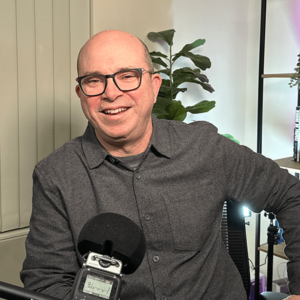
John Kerr is a veteran of Australian radio broadcasting with a career spanning more than five decades. He started at sixteen years old at 2PK in Parkes, New South Wales — reportedly the youngest announcer in the state at the time — and went on to work at stations across the country, spend eighteen months broadcasting from a pirate radio ship in the Irish Sea, and anchor the midnight-to-dawn program at 2UE in Sydney for nearly two decades. Along the way he interviewed John Wayne, Sean Connery, Louis Armstrong, Nancy Sinatra, and Larry Adler, among many others. He is also, for full disclosure, someone I had the privilege of working alongside for nearly seven years — and one of the people who shaped the way I think about conversation, broadcasting, and what it means to genuinely connect with an audience.
This episode was not an interview. It was a conversation. And that distinction, as you’ll hear, is everything.
How a Struggling Overnight Show Became a #1 Program Across 52 Stations
When John and I started working together on the midnight-to-dawn program at 2UE in 1993, the show was receiving an average of three or four phone calls an hour. For a talkback program, that’s essentially silence. We had five hours to fill every night, five nights a week — twenty-five hours of live radio per week — with almost no budget, no guests lined up, and just the two of us to make it work.
What happened over the following years still surprises me when I think about it. The program grew into a vibrant, nationally syndicated talkback show that at its peak was broadcast across 52 Australian radio stations, reaching every state except Western Australia (where the time difference made live talkback impractical). In Sydney, it was a rampant number one in its timeslot. We had regular guests from across the media industry — Tim Webster talking sport, Steve Lemon previewing the week on the Today Show, and through John’s extraordinary network of contacts built over decades in the industry, guests from the United Kingdom and the United States who were only available to us because while Australia slept, the rest of the world was awake.
None of those guests were paid. They came because John had spent years building genuine relationships with people — not transactional contacts, but real friendships forged through shared experience and mutual respect. It’s a lesson that applies just as powerfully to podcasting today as it did to overnight radio in the 1990s: the people who show up for you, who give their time and their stories freely, do so because of the relationship, not the fee.
The Difference Between an Interview and a Conversation
One of the central themes of this episode — and something John and I have both thought about deeply over the years — is the distinction between conducting an interview and having a conversation. It sounds like a subtle difference, but in practice it changes everything about the dynamic between host and guest, and between broadcaster and audience.
An interview is transactional. There’s a list of questions, a predetermined structure, a sense that the host is working through an agenda. The guest answers, the host moves to the next question, and the whole thing proceeds in a fairly predictable direction. It can be informative. It can even be entertaining. But it rarely surprises anyone, including the people having it.
A conversation is something different. It’s responsive. It follows the energy of what’s actually being said rather than what was planned in advance. It allows for tangents, for unexpected revelations, for the kind of moment where a guest says something that opens a door neither person knew was there. As John puts it, the best interviews are the ones that just sound like a conversation — not someone trying to hammer a point or demonstrate their interviewing prowess, but two people genuinely engaged with each other and with the ideas being explored.
This is something John learned early and practised throughout his career. It’s also something he was taught, in part, by John Laws — one of the most celebrated broadcasters in Australian radio history — who told him early on to stop projecting, stop trying to sound like a radio announcer, and just talk the way he would talk to someone at home or in the street. That advice, John says, changed the way he approached the microphone from that point forward.
For podcasters, the lesson is direct and practical. Stop thinking about your next question while your guest is still answering the current one. Stop treating the conversation as a vehicle for demonstrating how well-prepared you are. Listen — genuinely, actively listen — and let what you hear guide where you go next. The audience can always tell the difference.
Pirate Radio, the 1960s, and Broadcasting From the Irish Sea
One of the most extraordinary chapters of John’s career is one that most Australians would know little about: his time as a broadcaster on Radio Scotland, one of the pirate radio stations that operated off the coast of the United Kingdom in the mid-1960s.
The context is remarkable. The BBC at the time played just fifteen minutes of what they called “needle time” — recorded popular music — per day. In the era of the Beatles, the Rolling Stones, Cilla Black, and Petula Clark, fifteen minutes of rock and roll per day was, as John describes it, ridiculous. Into that gap came the pirate stations: illegal broadcasters operating from ships anchored three miles offshore in international waters, beyond the reach of British law, playing nonstop rock and roll to millions of listeners across the UK.
John joined Radio Scotland after travelling to the UK from Australia in 1966, initially intending to stay for just a few weeks. He ended up staying for eighteen months. The combined pirate stations were drawing millions of listeners per day. The names that came through those ships read like a who’s who of British broadcasting history — Tony Blackburn, who remains one of the UK’s most prominent media personalities to this day; Kenny Everett, a broadcasting genius John compares to Australia’s Doug Mulray; and, less admirably, Jimmy Savile.
The British government eventually moved to shut the stations down through the Marine Offences Act, which made it a criminal offence for any British subject to work on the ships. On 14 August 1967, pirate radio went silent. John came home to Australia and returned to 2UE for the first time.
What strikes me about this period of John’s career is not just the adventure of it — though it is genuinely adventurous — but what it represents in terms of building a global network and a breadth of experience that would pay dividends for decades. The connections John made during his time in the UK, and the understanding he developed of broadcasting in an international context, were part of what made our overnight program at 2UE so distinctive. We could call people on the other side of the world at three in the morning Australian time and have them on air within minutes, because John had spent years building those relationships.
The Interviews That Stay With You
Over the course of a fifty-year broadcasting career, John has had conversations with some of the most remarkable people of the twentieth century. A few stand out.
John Wayne, interviewed at the Dorothy Chandler Pavilion on the night he won his only Academy Award for True Grit. When John nervously asked if he minded being called by his first name, Wayne replied: “Well my friend, you can call me anything you like, so long as you’ve got a smile on your face when you say it.” It’s the kind of line that tells you everything about a person in a single sentence.
Sean Connery, interviewed on behalf of the Bob Rogers show — one of the few journalists Connery agreed to speak to during an Australian promotional visit. John, with his Scottish roots, talked about Scottish football and found an immediate connection. Louis Armstrong, whose name now graces a stadium at the US Open, interviewed at a time when simply being in the same room as him felt surreal.
Nancy Sinatra, in an interview that almost didn’t happen. The breakfast announcer at 2UE had already spoken to her that day and spent the entire conversation asking about her father, Frank — which Nancy had explicitly asked not to discuss. She was furious. John was warned in the strongest possible terms not to make the same mistake. He didn’t. He talked to Nancy about Nancy, about her music, about her own career and identity. She liked the conversation so much that she posted about it on Facebook immediately afterwards, mentioned John by name, and gave him her personal phone number at the end of the call with an open invitation to visit her in Los Angeles.
And then there’s Larry Adler — the legendary harmonica virtuoso — whose interview I remember more vividly than almost anything else from our years together at 2UE. John took a completely different approach to the obvious questions about Adler’s upcoming Australian tour, instead drawing him into stories about his early days, his friendships with Charlie Chaplin and other icons of the era, the texture of a life lived at the centre of twentieth-century culture. At the end of the interview, Adler told John it was the best interview he had ever given. That, to me, is the highest possible compliment a broadcaster can receive — and it came directly from the approach of going beyond the obvious, of finding the gold in the conversation that nobody else had thought to look for.
The Angela Lansbury Lesson: Always Be Prepared
For every great interview, there’s a cautionary tale. John’s is Angela Lansbury.
He was covering the Academy Awards for 2UE in 1970 when he was told, with almost no notice, that Lansbury had made herself available for an interview on the set of Bedknobs and Broomsticks. It was a genuine scoop. It was also a disaster. John wasn’t prepared — he hadn’t had time to be — and Lansbury, who is famously sharp and not inclined to suffer fools, knew it immediately. “You don’t know what you’re talking about, young man, do you?” she said. The interview, which John still has on cassette and has never played back, was the worst of his career by his own assessment.
The lesson he draws from it is simple and unambiguous: know your stuff. If you’re going to have a conversation with someone — in any context, but especially in a professional one — do your research. Know who they are, what they’ve done, why they’re in the news, what they care about. Go in loaded with information and you’ll almost certainly have a good conversation. Go in unprepared and you’ll pay for it, as John did with Lansbury, in ways you’ll remember for the rest of your career.
This applies directly to podcasting. The hosts who consistently produce the best conversations are the ones who have done the work before the recording starts — not to produce a rigid list of questions, but to understand their guest deeply enough to follow the conversation wherever it leads with genuine intelligence and curiosity.
Building and Keeping an Audience: Be Yourself
When I asked John what the secret was to building the kind of loyal, engaged audience we had at 2UE — the kind of audience that would ring other people in the middle of the night to tell them to call in and win a $6.95 KFC voucher — his answer was characteristically direct.
Be yourself. Be genuine. Be kind. Be interested in the people you’re talking to. Don’t be fake, because people spot fakeness quickly and they don’t forgive it. And if you have a particular style or persona, be consistent — because the moment you deviate from what your audience expects of you, you lose their trust.
He illustrated this with a story from his own career: a regular caller who had become a fixture of the program rang in one night after being kept on hold for forty-five minutes, and John, uncharacteristically, lost his temper and told her to go away in terms that were rather less polite than his usual manner. The switchboard lit up immediately — not with people agreeing with him, but with listeners who were genuinely unsettled by seeing a side of him they hadn’t seen before. The lesson, as John puts it, is that if your brand is being the warm, patient, interested host, you don’t get to suddenly be rude to an elderly caller and expect your audience to simply move on.
Authenticity, in other words, is not just a virtue — it’s a strategy. The broadcasters and podcasters who build lasting audiences are the ones whose listeners feel they genuinely know them, trust them, and can predict how they’ll show up. That trust is built slowly and can be damaged quickly.
Know Your Audience Outside the Studio
One of the most practical pieces of advice in this episode comes almost as an aside: know your audience outside the studio. John credits Alan Jones with teaching him this, and it was something we practised throughout our years together at 2UE — listener lunches, movie premieres, trips to Brisbane for events with the people who called in regularly and made the program what it was.
It sounds simple, but it’s something that many podcasters and broadcasters never do. They produce content, they publish it, and they interact with their audience only through the medium itself. What John and I found was that meeting listeners in person — hearing their stories, understanding their lives, knowing who they actually were rather than just what they sounded like on the phone — made us better at what we did. It deepened the connection, sharpened our instincts, and reminded us constantly of who we were actually talking to every night.
For podcasters, the equivalent might be responding to every comment, engaging in the communities where your listeners gather, or occasionally hosting events or meetups where you can meet your audience face to face. The investment is real, but so is the return.
What This Conversation Means for Podcasters Today
John Kerr’s career spans a period of broadcasting history that most people alive today have never experienced — pirate radio ships in the Irish Sea, the birth of commercial talkback in Australia, the pre-internet era when getting someone on the phone from the other side of the world at three in the morning was genuinely extraordinary. The technology has changed beyond recognition. The principles haven’t.
Listen more than you talk. Prepare thoroughly, then be willing to abandon your preparation when the conversation takes you somewhere better. Build genuine relationships with people, because those relationships will pay dividends in ways you can’t predict. Be yourself, consistently and authentically, because your audience will know immediately if you’re not. And remember that the goal is never to demonstrate how good an interviewer you are — it’s to create the conditions for your guest to say something they’ve never said before, in a way that makes your audience feel like they were there for something real.
That’s what John Kerr has been doing for fifty years. It’s what we tried to do together on the midnight-to-dawn program at 2UE. And it’s what the best podcasters are doing right now, whether they know it or not.
Podcasts Done For You helps business owners and experts create professional podcasts — from strategy and recording through to editing, publishing, graphics, and social media. To find out more or book a strategy session, visit podcastsdoneforyou.com.au